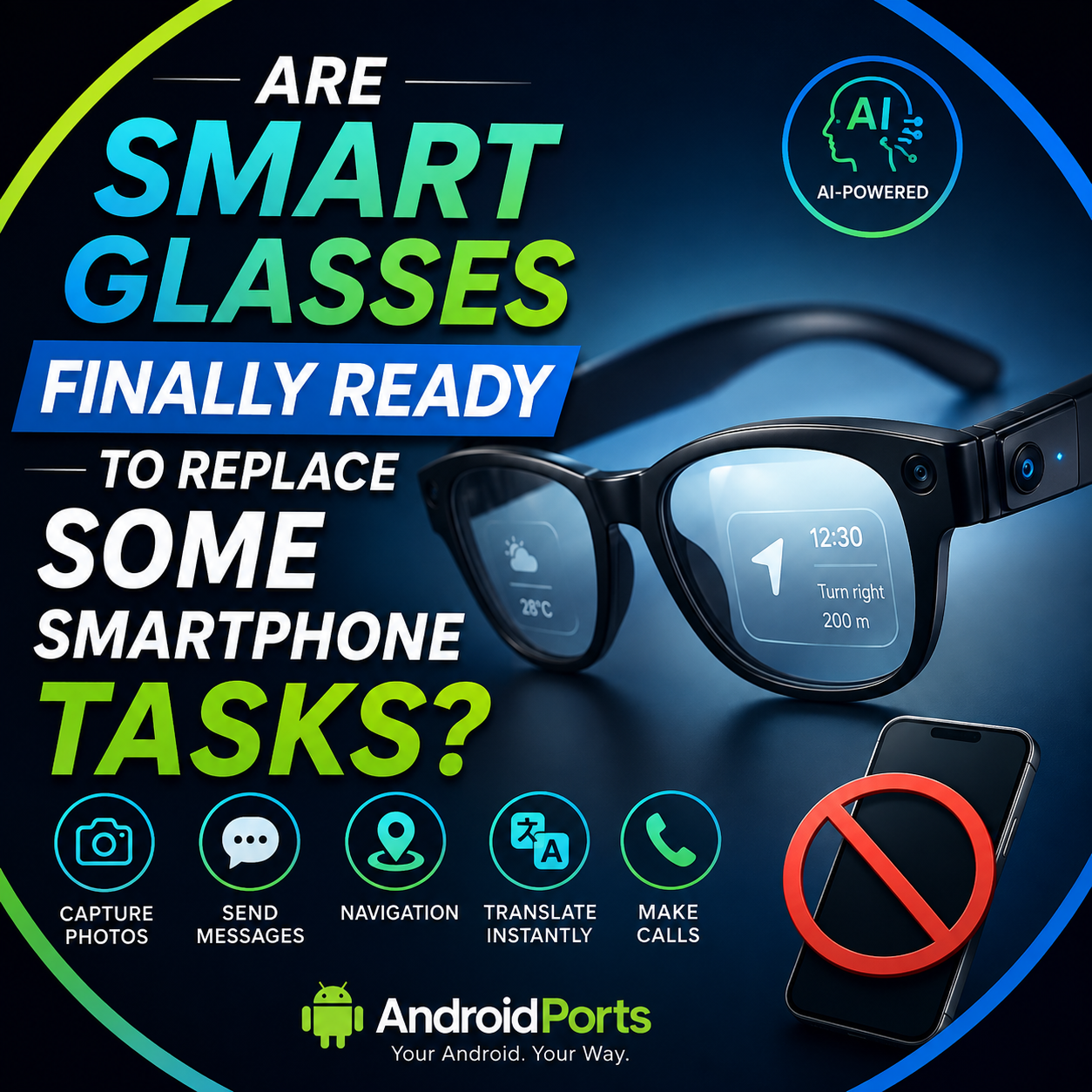
Smart glasses are becoming useful beyond taking photos. See which smartphone tasks AI glasses can already handle—and why your phone isn’t disappearing yet.
For years, smart glasses have promised to help us rely less on our smartphones. The truth is, the idea has usually outshined the actual products.
Early smart glasses were just awkward—bulky, pricey, or so limited that most people couldn’t bother wearing them day to day. But 2026 feels different. AI isn’t just a buzzword anymore; now it’s the main interface.
Forget past attempts to shrink a smartphone screen and strap it to your face. This new wave? It’s about cameras, microphones, speakers, AI assistants, and sometimes a tiny display. Google’s joining forces with Samsung and brands like Gentle Monster and Warby Parker to make Android XR eyewear. Their first audio-focused glasses are coming this fall, and versions with displays are in the works too.
Meta is also growing its AI-glasses ambitions, working with EssilorLuxottica on stylish new specs.
So the question probably isn’t, “Will smart glasses replace smartphones?” It’s more like, “Which of your usual phone habits won’t require you to pull your phone out anymore?” That’s where smart glasses are starting to get interesting.
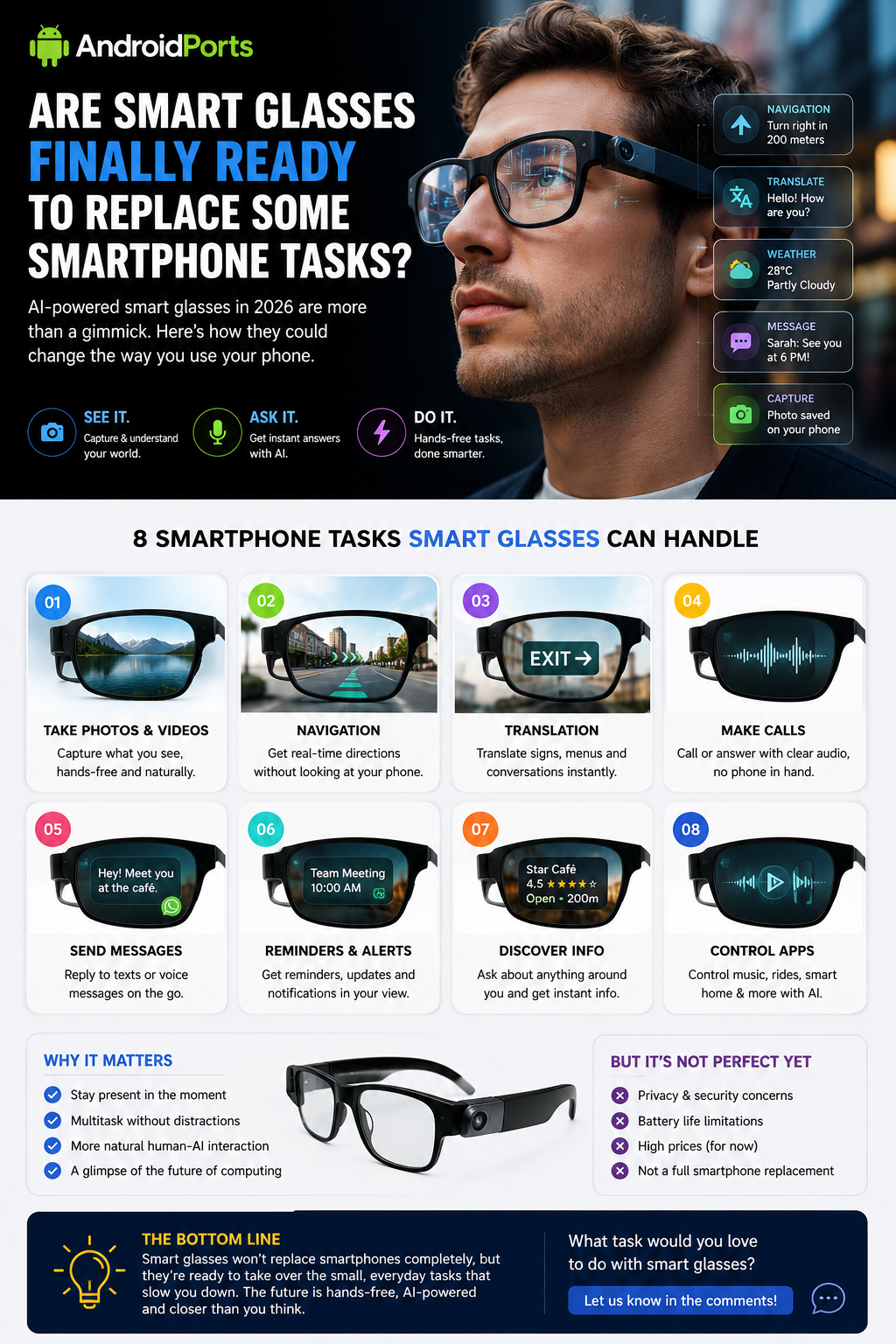
1. Taking Photos—No Phone Needed
Right now, grabbing quick photos is one of the most natural things you can do with smart glasses that have a camera. Instead of spotting something cool, digging out your phone, unlocking it, launching the camera, and then missing the moment, you just capture what you’re seeing—from your actual perspective.
Google says its next-gen glasses will let you snap hands-free photos and videos. Plus, you’ll get AI photo edits with Gemini. It’s a big shift: you’re not just recording what your phone’s pointed at—you’re capturing what you’re experiencing. For travel, family outings, sports—this could be a game changer.
Of course, that introduces some privacy headaches too. But we’ll circle back to that.
2. Asking AI About What You See
This could be the killer feature everyone’s been waiting for.
Picture yourself strolling through a city. You spot an old building and wonder what it is. Instead of pulling out your phone, opening Google, and typing a description, with AI-enabled glasses you could just ask, “What building is that?”
Because these glasses use cameras to see your surroundings, the AI can figure it out without much explanation. Google’s planning for Gemini to answer questions based on what you’re actually looking at, whether it’s identifying a landmark or giving info on a nearby restaurant.
That’s something you just can’t do with a regular AI chatbot on your phone—not without extra effort. You don’t have to spell out the context; the glasses already “see” it for you.
3. Navigation Without the Hassle
How many times do you wander around a new city, glued to your phone for directions? Check the map, walk fifty steps, check again, realize you’re lost, backtrack. Repeat.
With smart glasses, that whole experience becomes a lot smoother. Google says their new eyewear will know where you are and which way you’re facing so Gemini can give you turn-by-turn directions.
Eventually, glasses with displays might show navigation right in front of your eyes. For travelers, cyclists, and walkers, that hands-free guidance could be a leap forward.
4. Real-Time Translation
Here’s another area where smart glasses shine.
Imagine you’re in Japan, staring at a sign you can’t read. Normally, you’d fumble for your phone and use an app. Now? Just look at the sign and let your glasses translate. Google promises their glasses will handle both written text and spoken translation, even reading menus and signs out loud.
It doesn’t stop there—these glasses could help you converse across languages, hearing translations as you speak. For travelers, that’s a powerful tool.
5. Sending Messages Without Your Thumbs
Smartphones have their limits, especially when you’re on the move. Typing while walking is just annoying. But with voice-controlled glasses, you can send quick messages, make calls, or catch up on missed texts, all hands-free.
Google’s planning for users to send texts and get call summaries without touching their phones. Picture moving through a crowded airport and simply saying, “Tell Sarah my flight’s delayed by 40 minutes.” Much easier than digging out your phone on the go.
Of course, you won’t want to dictate entire essays. But for quick interactions? It works.
6. Making and Receiving Calls
Wireless earbuds already let us ditch the phone during calls, but smart glasses take that further—built-in speakers and mics mean you can talk without blocking out the world around you. Add AI and you can also get summaries, ask questions, and interact with apps right through your glasses.
That’s a big deal: the best wearables are always “just there” when you need them, not another device you have to keep fishing out.
7. Controlling Apps with AI
This could be the moment everything changes. Smart glasses don’t need to run every app themselves. Instead, AI acts as your middleman.
Google says Gemini on their new glasses can interact with phone apps—book you a ride, complete basic tasks, prep an order for you. The idea? Today, you steer the app. Tomorrow, you tell the AI what you want and let it drive.
If this gets reliable, smart glasses won’t need massive displays to be useful.
8. Getting Info Without Dropping Your Gaze
It might seem trivial, but think about how often you glance at your phone: weather, texts, reminders, directions, notifications, translation. Smart glasses could move those little check-ins from your phone to your field of vision or your ear.
Google’s working on audio-only glasses (info through sound) and display glasses (showing info when needed). That difference matters—audio glasses keep your phone in your pocket, display glasses reduce how often you look at it.
So, Can Smart Glasses Replace Your Phone?
Not yet—and maybe that’s not even the right goal.
Smartphones still rule when you need a big screen: editing spreadsheets, watching movies, writing long emails, comparing products, managing files, playing games. For all that, the phone wins.
What smart glasses really do is chip away at those small, constant phone moments.
Think of Smart Glasses as Your Phone’s Remote Control
Here’s an easy way to see it: your phone stays the powerhouse, the hub for connectivity and computing. The glasses? They’re your new interface—sitting right on your face.
Google’s Android XR vision is built around this idea: glasses connect with your phone and access your apps, but keep your hands free. So instead of always grabbing your phone, you use voice, sight, AI, audio, and (if needed) a small display.
This is why AI suddenly makes smart glasses so much more useful. They don’t need a clunky visual interface if you can just ask for what you need.
But Here’s the Big Issue: Privacy
The tech’s racing ahead, but social acceptance? Not so much. Camera-equipped glasses raise a simple question: how do you know if you’re being recorded?
In the UK, it’s already stirred up concern. Just this week, cinemas considered new rules on smart glasses because of privacy and piracy worries. Courts have banned them, too.
Workplaces are asking how to make sure no one’s being secretly recorded. For smart glasses to catch on, manufacturers need to design better recording indicators, solid privacy controls, and make some new social rules.
Smart Glasses vs Smartphones
| Task | Smartphone | Smart Glasses |
|---|---|---|
| Quick photo | Good | Potentially better |
| Walking navigation | Good | Potentially better |
| Translation | Good | Potentially better |
| AI questions about surroundings | Good | Potentially better |
| Calls | Good | Very convenient |
| Quick messages | Good | Convenient |
| Long messages | Better | Limited |
| Video streaming | Better | Limited |
| Gaming | Better | Limited |
| Productivity | Better | Limited |
| Complex web browsing | Better | Limited |
| Privacy around others | Familiar issues | Major challenge |
There’s Another Side—Accessibility
Don’t forget, smart glasses are changing things for folks with disabilities. They offer hands-free assistance for people with visual or physical challenges: reading, navigation, daily tasks. That shows why these devices aren’t so simple to judge. A camera that raises privacy concerns might be someone else’s lifeline.
The real challenge is making these glasses genuinely helpful—without making everyone around you feel like they’re being watched.
Android’s Big Role
For AndroidPorts.com readers, here’s where things get exciting. Google isn’t treating this as a side project: Android XR is a full platform for headsets and glasses, built with Samsung and Qualcomm. Google is also working with major fashion brands to make eyewear that looks like…normal glasses.
People don’t want to wear computers on their face. If these companies can nail good-looking frames, useful AI, all-day battery life, and bring in the Android app ecosystem, smart glasses go from geeky gimmick to mainstream gear.
Privacy around others Familiar issues Major challenge
It’s a clear pattern. Smart glasses work best for quick, contextual, hands-free actions. For anything that needs a bigger screen or lots of interaction, your phone’s still king.
Your Smartphone Isn’t Dying—It’s Simply Staying in Your Pocket
This is where tech seems to be going. Your phone won’t disappear—you’ll just pull it out less often.
Think about your day: your glasses point you the right way, read out messages, send replies, tell you what you’re looking at, grab a picture, translate signs, start your music, order a ride. For everything else, for the big tasks, you still reach for your phone.
That could cut out dozens of tiny phone-checks every day. Honestly, that’s a lot more believable than “glasses replace phones completely.”
Final Thoughts
Smart glasses in 2026 finally seem to be growing up. With AI, cameras, mics, speakers, optional displays, and phone integration, they’re set to tackle the small stuff that takes up big time on our phones.
Google’s new Android XR eyewear reflects this shift—navigating, messaging, taking photos, translating, AI help, app interactions—all without constantly grabbing your phone.
Of course, hurdles remain: privacy, comfort, battery life, price, and whether people feel okay about wearing them all day. And the pushback, especially over cameras, shows that being technically impressive isn’t enough.
So will smart glasses replace your smartphone in 2026? No.
Are they finally ready to replace some reasons you keep reaching for it? Yes—and that’s a new chapter.
For AndroidPorts.com, smart glasses are definitely worth watching. Android is pushing beyond just phones, and if Android XR becomes a big platform, today’s Android app world could soon stretch to a whole new set of devices.
FAQs
Can smart glasses replace a smartphone in 2026?
No, not entirely. They’re getting better at quick tasks: taking photos, navigation, sending messages, making calls, translating, and simple AI interactions—but screen-heavy stuff still goes to your smartphone.
What is Android XR?
It’s Google’s Android platform for XR devices—smart glasses and headsets—in partnership with Samsung and Qualcomm.
When are Google’s smart glasses coming?
Google says the first audio-focused models are launching fall 2026. Frames will come from partners like Gentle Monster and Warby Parker.
Will Android XR glasses work without a phone?
They’re meant to pair with your phone, not replace it. Glasses talk to your phone’s apps and give you a hands-free interface.
Can smart glasses translate languages?
Yes—Google’s announced real-time translation for both speech and written stuff, like menus and signs.
Can smart glasses take photos and videos?
Camera-equipped models can. Upcoming Google glasses will have this, and other brands already offer similar features.
Are smart glasses a privacy risk?
Absolutely. Cameras on glasses are less obvious than a phone, and that’s causing concern—and venue bans—as these products become more common.
Will Android apps eventually work on smart glasses?
Android XR is a whole ecosystem for XR devices, but don’t expect your regular phone interface right in front of your eyes. Google’s focusing on AI, voice, context, and experiences built for eyewear.
Are smart glasses worth watching in 2026?
Definitely. With Google, Samsung, Meta, and more investing, 2026 will be a pivotal year for AI glasses moving from the early adopters to the mainstream.
Leave a Comment