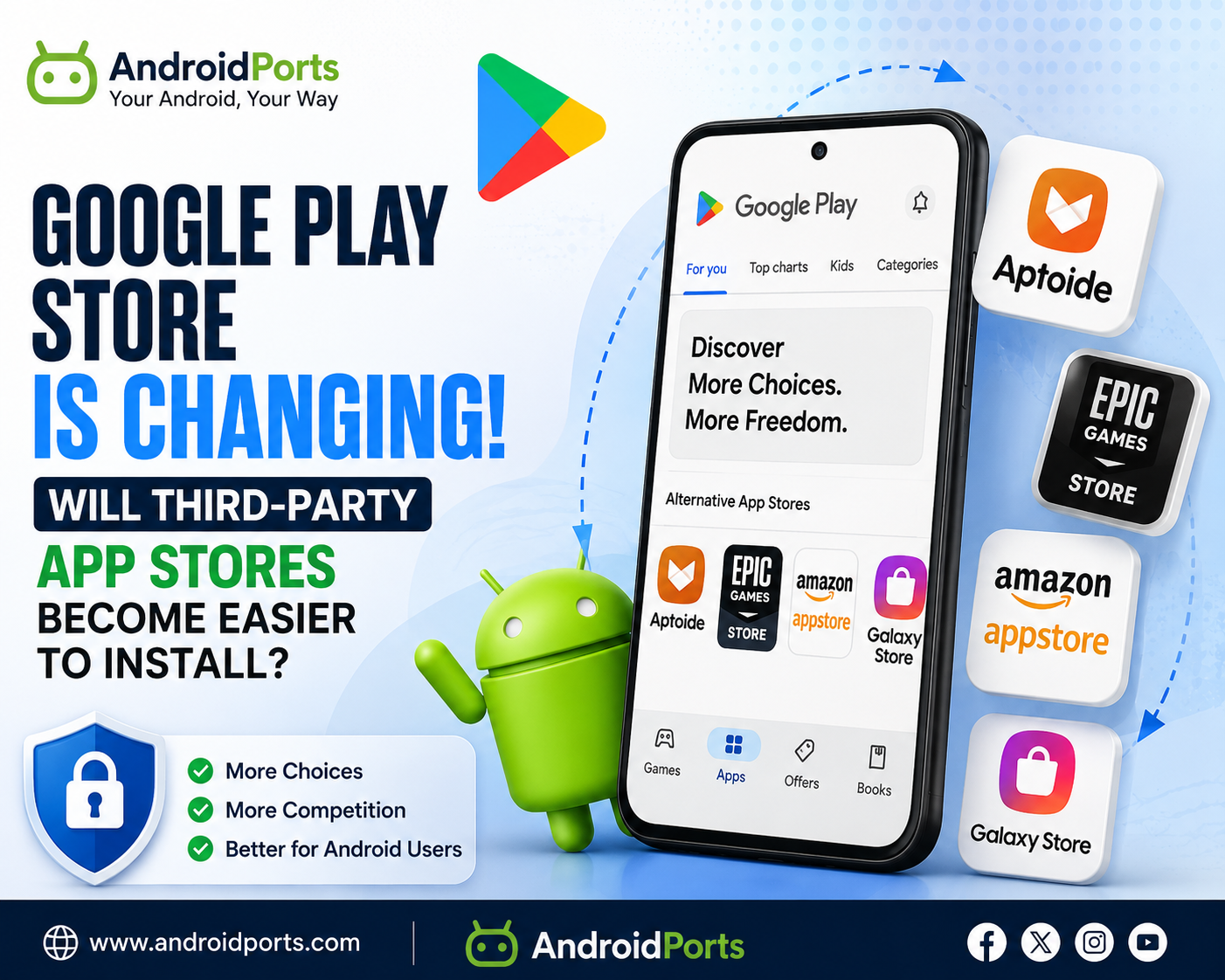
Google Play Store Changes 2026. See why third-party app stores are appearing inside Google Play and what it means for APK users.
Android has always been about choice. People loved that about it—you could grab apps from Google Play, download APKs straight from developers, or browse other marketplaces completely outside Google’s ecosystem. But let’s be real: actually setting up a whole third-party app store on Android was never as smooth as installing something directly from Google Play.
Now, in the U.S. at least, that’s changing—and fast.
Thanks to the Epic Games vs. Google legal fight, we’re seeing rival app stores show up right inside Google Play. Aptoide was the first to jump in and take advantage of this new setup in August 2026. And a brand new court order—just a few days old—could make it way easier to find and install these stores.
For folks who geek out about APKs, sideloading, and just running apps outside the Play Store, this shift could turn into one of the biggest stories of 2026.
Wait, third-party app stores inside Google Play Store?
Yes, you read that right.
It’s a pretty wild development.
Before this, anyone who wanted a different app marketplace had to track it down online, download the APK, and deal with those pop-ups about “installing from unknown sources.” Now, U.S. court orders have forced Google to allow eligible competitors directly onto Google Play.
Aptoide Games is the first big example. After more than ten years, it’s back on the Play Store in the States.
So, just imagine this: you open up Google Play, spot another app store, install it like any other app, and start browsing a whole new set of apps right from there.
That’s huge.
Of course, things aren’t totally smooth yet.
Even though competitors are allowed onto the Play Store, there’s been a lot of friction. Epic Games pointed out—with plenty of proof—that searching for these alternative stores sometimes pulls up totally unrelated results. Even worse, you might have to tap “View” before you actually see an “Install” button.
Judge James Donato wasn’t having it. So, he ordered Google to cut out the extra steps and make it simpler for people to find and install these new stores. And he gave them about a week to get it done.
So, here in the U.S., the answer is finally: yes, third-party app stores are supposed to get easier to install. But hold on—there’s a catch.
Not every Android user is getting this right away
This whole change is about the U.S. market. If you’re using Android in India, Europe, or pretty much anywhere else, don’t expect your Play Store to act any differently just yet. Still, the direction is clear.
Google and Epic are already talking about making these changes broader, like setting up a registration program for other app stores to offer more integrated installs. So, what starts as a U.S.-only remedy could reshape Android distribution everywhere, eventually.
What’s Aptoide doing on Google Play Store?
Aptoide has been around for ages as an independent Android app marketplace. It doesn’t mean every Android user will suddenly flock to it, but it’s proof that this new distribution model is actually rolling out—not just discussed in some court filing. For the first time, a rival store is being distributed straight through Google’s own platform. That’s a big symbolic shift.
Why would anyone want another app store?
Fair question. The Play Store already has millions of apps—so what’s the point?
A few reasons:
Different app selection: Some stores focus on specific games, categories, or communities you won’t find elsewhere.
Different terms for developers: Not everyone loves Google’s commission and payment setup. Alternative stores might offer better deals or run their own promos.
Competition: More stores means more options and can push everyone to offer better discovery, prices, and experiences.
Regional focus: Local app stores could matter more in different parts of the world.
Gaming: Imagine big gaming brands creating their own Android stores. You’d get different collections, deals, and maybe exclusive content, all while still using your phone as usual.
That would shake things up. It’s not just “here’s one app store, deal with it” anymore.
Does this mean Google Play is going away?
No chance. Opening Google Play to rivals doesn’t make it irrelevant. It’s still central to Android—it’s tied into the hardware, has a massive user base, and runs the core payments and security features everyone relies on.
This is about creating more choice, not pushing Google Play aside. Think of it like this: Google Play stays the main app store, but sometimes acts as a door to other stores. New model, same Play Store—just with more options.
What about APK downloads?
Now it gets especially interesting for anyone who likes sideloading.
Installing an APK is simple: you grab a file and load the app directly, without any store involved.
Installing a third-party app store is different: you’re adding a whole new marketplace that can help you discover, install, and update more apps.
The new U.S. Play Store changes focus on the second category—they won’t kill off APKs. If anything, Android’s whole relationship with software outside Google Play is in the middle of another big change.
There’s more: big changes starting in September
This is where things get confusing. At the same time that alternative stores are getting easier to find, Android is about to require stronger developer verification for any app distributed outside Google Play.
That might sound contradictory, but each policy is tackling a different problem.
Android now verifies the identity of developers distributing apps on certified devices. Starting in September 2026, the rule kicks in for Brazil, Indonesia, Singapore, and Thailand. Unverified developers won’t be able to distribute new apps for installation on certified devices, and this will roll out to other regions from 2027 and beyond.
Importantly, Android has crafted a special installation process to keep sideloading alive for advanced users.
So overall, what’s really happening is:
- Android users get more choices on where to find apps,
- but there’s also tighter verification on who wrote those apps.
Saying Android is just “opening up” or just “locking down” is way too simple.
Could alternative app stores become safer?
That’s actually one of the most interesting side effects.
Up to now, a big risk with third-party stores was simply tracking down their installer. Who knows if that app-store APK you found is legit?
Now, being able to get rival stores directly from Google Play means you’re starting from a place you already know and trust.
Of course, not every app inside those stores is guaranteed safe. You still need to check who’s running the store, who made the app, what permissions it asks for, and how it handles security. But removing the need to search random websites just to get another app market does make the overall experience a lot less sketchy.
What about the Epic Games Store?
Since Epic started the whole court fight, a lot of people will wonder, “So, will Epic Game Store appear?” Well, the door is open now—the new rules mean eligible markets can participate. But AndroidPorts isn’t betting on every marketplace jumping in on day one. Every company needs to look at the tech requirements, business, policies, and whether joining makes sense for their customers.
The real point? The opportunity exists now.
And Amazon’s Appstore?
Same story. There have always been other Android marketplaces, but being discoverable directly through Google Play changes user acquisition. Before, getting someone to install another store could be a big ask with too many weird steps. If it turns into a simple search → install → open, that’s way less friction.
Whether big names take advantage, we’ll have to wait and see.
Why developers should care
This isn’t just about end users. For developers, the whole idea of Android distribution could get a shakeup.
Instead of only thinking, “How do I get onto Google Play?” it’ll be, “Which distribution channels make sense for my app?”
Competition between stores can push things like:
- Commissions
- Payment choices
- Promo opportunities
- App discovery
- How subscriptions work
- Reach into different regions
Better terms won’t be guaranteed everywhere, but developers will have more paths to consider.
Why Android users should care
Most people won’t go out and install five app stores tomorrow. But it’s like web browsers—nobody needs a dozen browsers installed, but knowing you have a choice keeps the main players on their toes.
Alternative stores could act the same way. Google Play stays the “default,” while specialists or gaming stores pick up people interested in unique catalogs, better deals, or alternative experiences.
Android is becoming both more open and more verified
That’s what’s so interesting about Android in
Leave a Comment